Latest insights
How to choose an ACSP — and how a firm becomes one (2026)

August 21, 2026
By directorverifications.com team
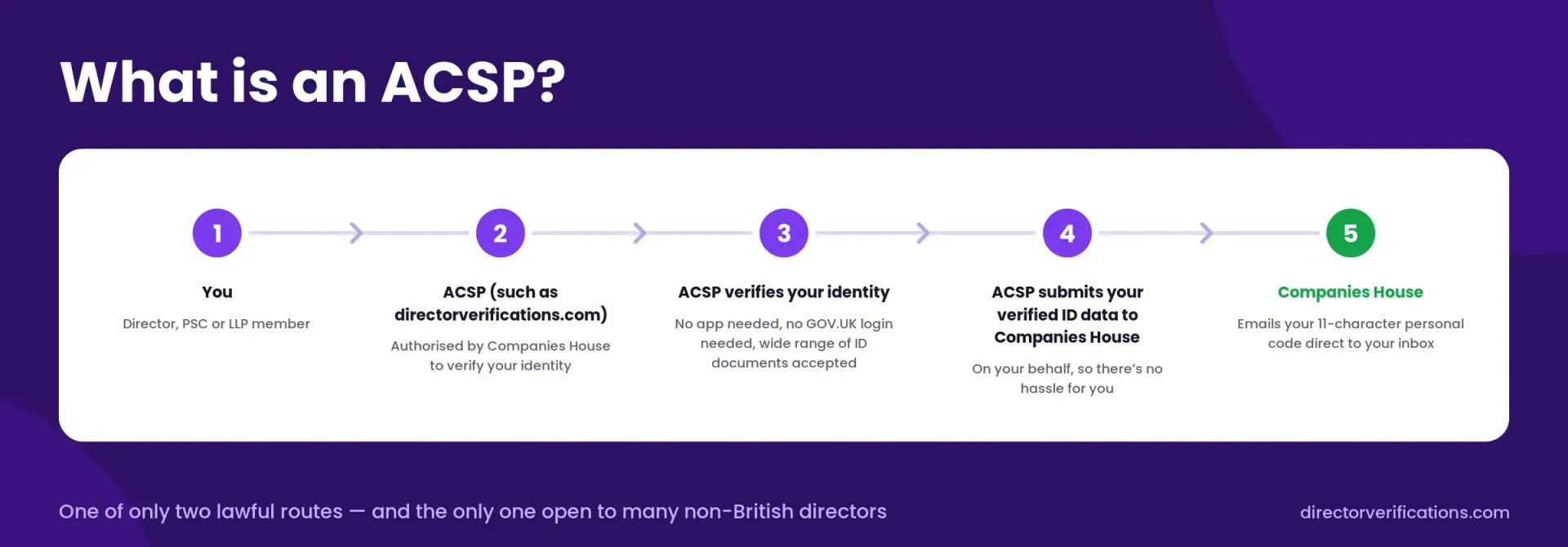
In short: an ACSP (Authorised Corporate Service Provider), also called a Companies House authorised agent, is a business authorised by Companies House to verify identities on its behalf. This page is about the two questions that follow from that: how you set about choosing one, and what a firm has to do to become one. To register, a firm must already be supervised by a UK Anti-Money Laundering supervisory body, and its own senior people must be identity-verified first. If you’re an individual who needs verifying — particularly a non-British director — using an established ACSP such as directorverifications.com takes minutes and costs £24.99, and the process is completed within 24–48 hours.
Two very different people search for "ACSP registration".
The first is a director, PSC or LLP member who has been told they must verify their identity, has seen "ACSP" on a Companies House letter or a GOV.UK page, and wants to know what it means for them.
The second runs an accountancy or law firm and is weighing up whether to become an ACSP themselves.
This guide answers both, because the two questions turn out to be closely connected — and the answer for most individuals is that becoming an ACSP is neither possible nor necessary. What you need is to use one. That is what directorverifications.com does.
First, the one-line answer
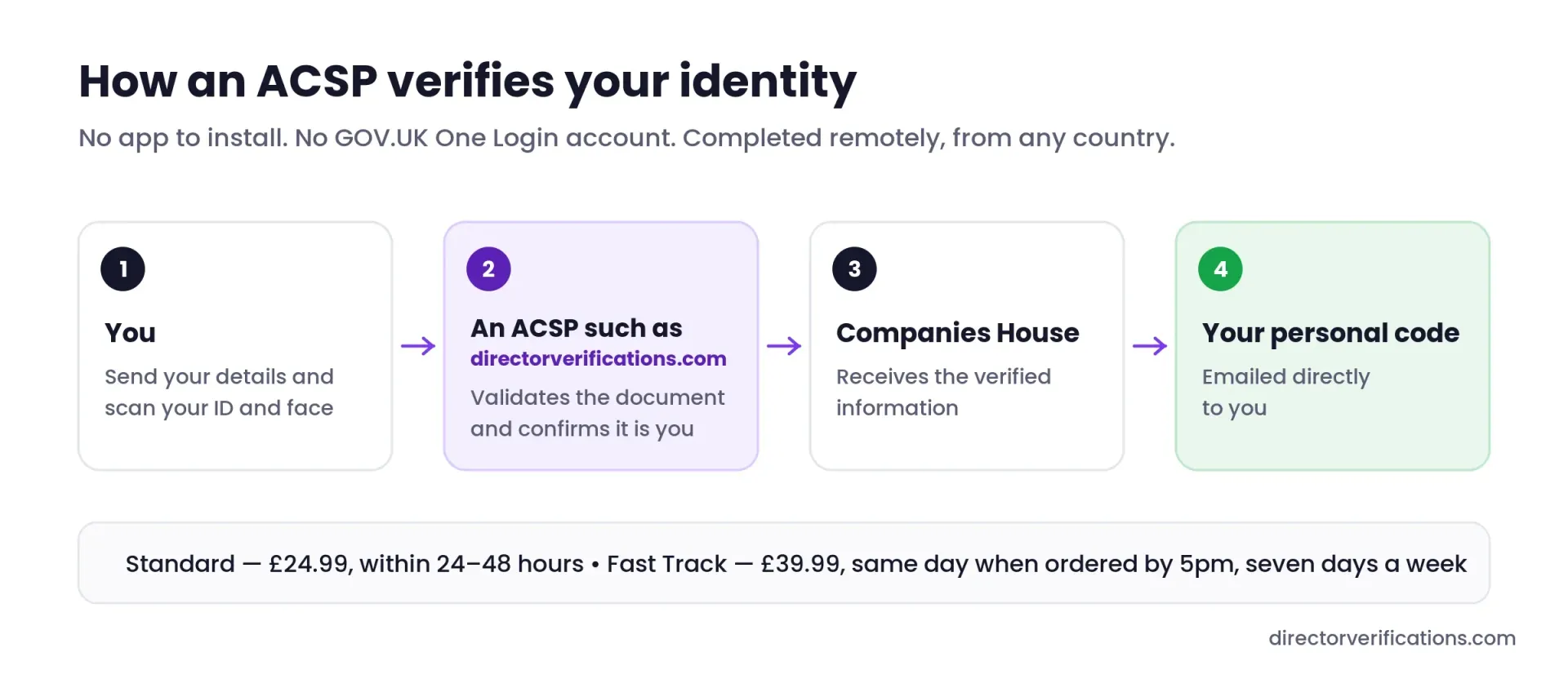
An ACSP — Authorised Corporate Service Provider, also known as a Companies House authorised agent — is a business that Companies House has formally authorised to carry out identity verification checks on other people's behalf and to report the results into the official Companies House ACSP portal.
In practice, ACSPs are accountancy practices, law firms, company formation agents and specialist identity verification services. directorverifications.com sits in that last category: it is the trading name of Finovium Limited, a firm of accountants, tax and business advisers based in Chelsea, West London, which has been advising businesses for over ten years.
The defining feature of an ACSP is not technology or price. It is supervision. Companies House will not authorise a business unless that business is already registered with a UK Anti-Money Laundering (AML) supervisory body — HMRC, or a professional body such as the ICAEW or the SRA. That is what makes an ACSP a trusted intermediary rather than simply a middleman.
Under ECCTA, verification through an ACSP is not a workaround or a second-class option. It is one of only two lawful routes, sitting alongside GOV.UK One Login, and it is checked against exactly the same Companies House standard. Our page on what an ACSP verification service is explains the customer-facing side in more detail.
Why the ACSP route exists at all
The Economic Crime and Corporate Transparency Act 2023 changed something fundamental. For most of the history of the UK register, you could become a company director with little more than a name and an address. No ID check. That made the register cheap to use — and cheap to abuse.
From 18 November 2025, every director, director-equivalent (including LLP members, general partners and managing officers), director of an overseas company registered in the UK, and Person with Significant Control must verify their identity. Companies House has estimated that 6 to 7 million people fall within scope.
Verifying that many people through a single government portal was never realistic — and the government did not attempt it. The ACSP framework distributes the work across the regulated professional sector, and, importantly, brings in a much wider range of acceptable documents than the self-service route can handle. That second point is the one this guide keeps returning to, because it is where the ACSP route stops being a convenience and starts being a necessity.
Who can register as an ACSP?
Companies House sets a clear bar, and it applies UK-wide — there is no separate English, Scottish, Welsh or Northern Irish ACSP registration.
To apply, the business must:
- Already be registered with a UK AML supervisory body. Not every business is eligible for AML supervision, so this is the first gate.
- Have the application submitted by someone in a senior role — a director, general partner, partner or member. Sole traders can register themselves.
- Have that person complete their own identity verification first. You cannot verify others until you are verified.
- For a limited company or LLP, supply the company number, company authentication code, correspondence address and correspondence email.
- Supply the names of its AML supervisory bodies and the AML membership numbers, which Companies House checks against the supervisory body's own records. If the names or numbers do not match exactly, the application is rejected.
- Accept the ongoing legal responsibilities — remaining AML-supervised at all times, notifying Companies House of changes, and keeping records and providing further information about filings on request.
A point that surprises people: individuals cannot register as an ACSP in a personal capacity. It is a business-level authorisation. If you are a single director trying to solve your own verification problem, ACSP registration is not the answer — using an ACSP like directorverifications.com is.
The ACSP registration process, step by step
- Confirm AML supervision. Check your registration is live and that your supervisory body holds the exact name shown on the Companies House register. Mismatches here are the most common cause of rejection.
- Verify your own identity for Companies House and obtain your personal code. If you have not done this before you start, the service will stop and ask you to.
- Tell Companies House about the business — company number, authentication code, addresses and correspondence email. Business sector is optional.
- Supply AML registration details — supervisory body names and membership numbers.
- Confirm your legal responsibilities.
- Choose whether to appear on the public ACSP list. Companies House publishes a list of ACSPs who have asked to be included — it is not a complete list of every authorised agent.
Once registered, you get an authorised agent account and can add colleagues to it.
What an ACSP must actually do to verify you
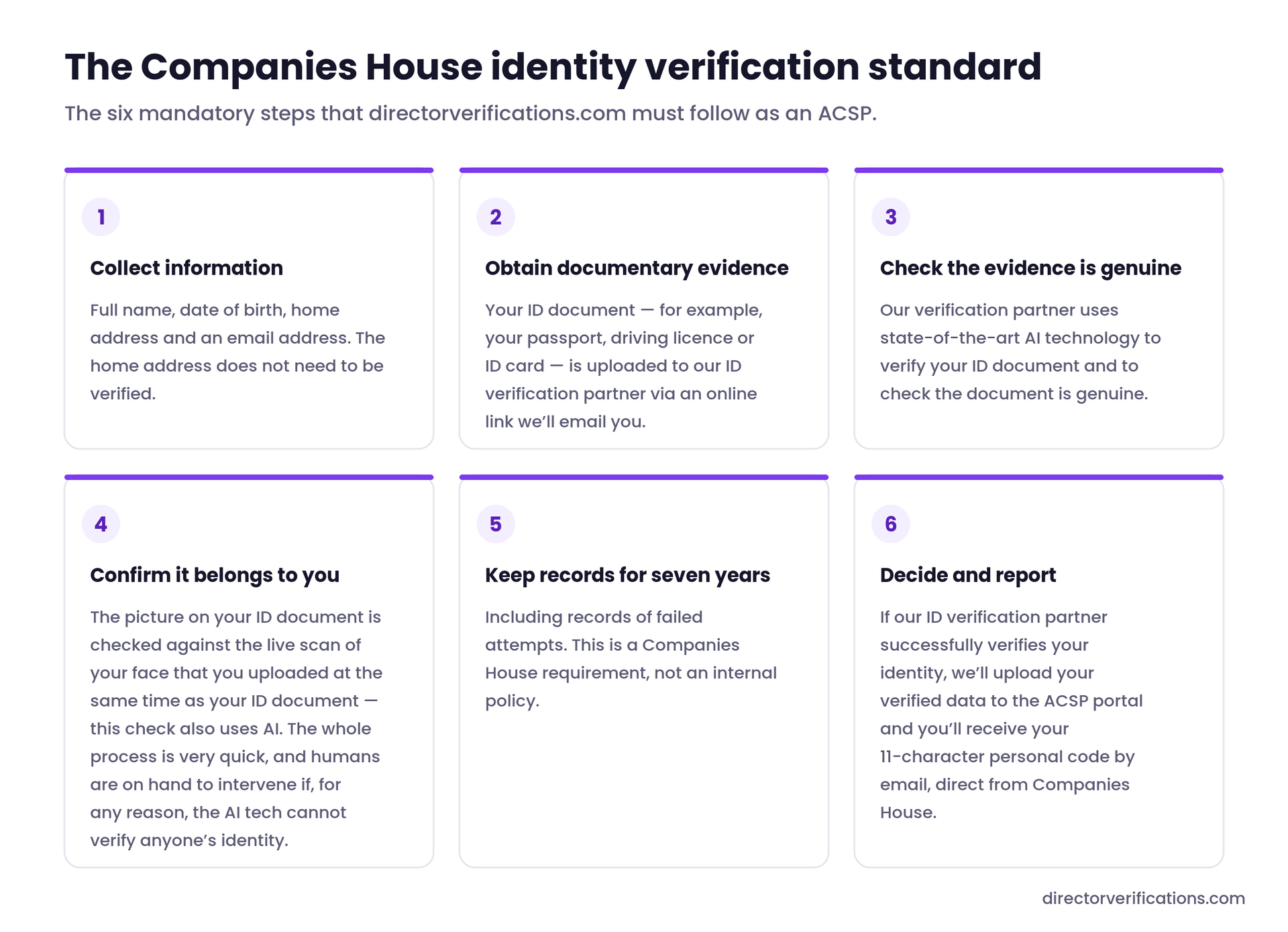
This is the part of the framework that most guides skip, and it is worth understanding whether you are choosing an ACSP or becoming one. Companies House publishes a mandatory identity verification standard with six steps. An ACSP that fails to meet it can be suspended or stopped from acting.
Step 1 — Collect information. Full name, date of birth, home address and email address. The address is recorded, not verified — proving where you live is not part of the check.
Step 2 — Obtain documentary evidence. Under Option 1, the ACSP uses identification document validation technology (IDVT) to validate the cryptographic and physical security features of a single photographic document. Under Option 2, a trained person checks two documents.
Step 3 — Check the evidence is genuine, including checking for tampering and contacting the issuing authority or relevant embassy where there is doubt.
Step 4 — Confirm the identity belongs to the person, including a live facial comparison against the document photograph where the check is done remotely.
Step 5 — Keep records for seven years, including records of failed attempts.
Step 6 — Decide whether the standard has been met, and report to Companies House.
Two consequences follow. First, a credible ACSP is doing substantially more than photographing a passport. Second, the record-keeping obligation is real — which is one reason many firms conclude it is more sensible to use an established ACSP such as directorverifications.com than to build the capability in-house.
Which documents an ACSP can accept — and why this matters most to non-British directors
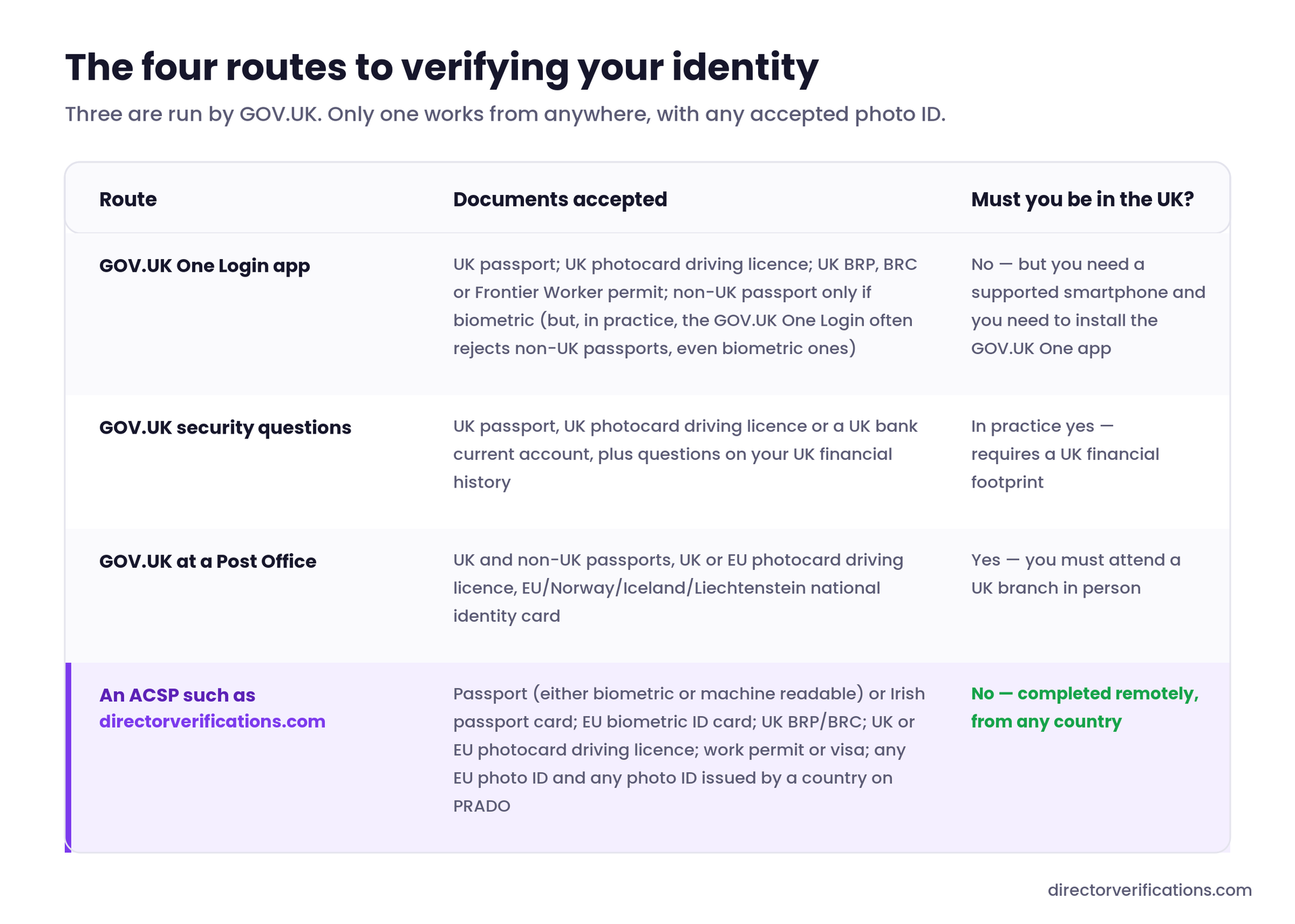
Here is the practical difference between the two routes, set out plainly.
| Route | Documents accepted | Must you be in the UK? |
|---|---|---|
| GOV.UK One Login app | UK photocard driving licence; UK passport; non-UK passport only if biometric; UK BRP, BRC or Frontier Worker permit | No, but you need a supported smartphone |
| GOV.UK at a Post Office | Not open to you once GOV.UK One Login has refused you | Yes — you must attend a UK branch in person |
| ACSP (e.g. directorverifications.com) | Passport or Irish passport card; EU/Norway/Iceland/Liechtenstein biometric ID card; UK BRP/BRC; UK, Channel Islands, Isle of Man or EU photocard driving licence; photographic work permit, immigration document or visa; and more | No — checks can be completed remotely from any country |
Read that table alongside a simple fact: a very large number of EU citizens hold a national identity card and no passport at all.
For that director, the One Login app is closed — it does not accept EU national ID cards. And once GOV.UK One Login has refused them, the Post Office route isn’t open to them either. The only route genuinely open to them is an ACSP, and it can be completed from wherever they are.
There is a bigger problem than any of that, and almost nobody is told about it. If GOV.UK One Login refuses to verify you once, that is the end of the government route: you do not get a second attempt, and you cannot fall back on the Post Office option either, whatever the guidance says is available. You are locked out of GOV.UK One Login for an indeterminate period — often several weeks, sometimes several months. We know this at first hand as well as from our customers: when the government route would not verify our own director’s identity, we rang the Companies House helpline and were told plainly that the only route left was to use an ACSP.
The same applies to a director holding a non-UK driving licence but no biometric passport, and to anyone whose non-UK passport predates biometric chips.
From what customers repeatedly tell us, even holding a biometric passport is no guarantee — we hear regularly from overseas directors whose app-based attempt simply failed, with no useful explanation and no easy second attempt. Our guides on the problems with verifying directly through Companies House and on director ID verification for non-British passport holders cover this in depth, as does our page on why ID verification is needed for non-UK citizen company directors.
Worth repeating, because it is the single most reassuring thing we tell overseas customers: you do not need a passport to verify with directorverifications.com.
How to choose an ACSP: a six-point checklist
Companies House recommends looking at an agent's reputation and experience. Here is a more practical version.
- Confirm they are actually authorised. Check the public ACSP list, and check the separate list of ceased and suspended ACSPs. Both are published by Companies House.
- Check who is behind the service. An ACSP must be AML-supervised. directorverifications.com is run by Finovium Limited — approved by Companies House as an ACSP, authorised by HMRC as a registered tax agent, registered with the Information Commissioner's Office, and HMRC-certified as AML compliant.
- Ask which documents they accept. If you hold a non-UK national ID card or driving licence, ask before you pay.
- Ask what happens when the technology fails. At directorverifications.com, a trained human reviews your documents in the small number of cases where automated checking cannot confirm a match — rather than issuing a flat rejection.
- Check the turnaround, and whether it is guaranteed. Standard verification through directorverifications.com is completed within 24–48 hours; Fast Track is guaranteed same day if your order arrives by 5pm, seven days a week.
- Check what they require of you. directorverifications.com does not ask you to install an app, and you will never need a GOV.UK One Login at any stage.
What gets published about your ACSP
When you use your personal code to connect your verified identity to the Companies House record, the register displays a verification statement showing your name, the date of verification, the name of the ACSP that verified you, and the AML supervisory bodies that ACSP is registered with.
Your identity documents themselves are never published. But the ACSP's name is — which is a good reason to choose an established, properly supervised provider.
Using an ACSP: what the process looks like from your side
Becoming an ACSP is a project. Using one takes minutes.
- Choose your service at directorverifications.com — Standard at £24.99, completed within 24–48 hours, or Fast Track at £39.99 for guaranteed same-day turnaround when ordered by 5pm, seven days a week.
- Follow the emailed link and scan your government-issued ID document and your face. No app installation.
- Our verification partner completes the check using enterprise-grade biometric AI accredited to ISO 27001, eIDAS 2.0, ETSI, IEEE 2089.1-2024, NIST Level 1 & 2 PAD and ISO 30107-3 Levels 1 and 2 — with human review where needed.
- directorverifications.com submits your verified identity to the Companies House ACSP portal.
- Companies House emails your 11-character personal code directly to you, usually within a few hours. See our guide on what the Companies House personal code is and how to use it.
- Connect the code to your roles — via your company's confirmation statement if you are a director, or the PSC service if you are a PSC.
Your personal code is the thing that proves you are verified, so it is worth understanding properly. Our full guide covers the format, your exact deadline and what to do when something goes wrong: Companies House personal code.
Firms verifying several people at once should look at our
bulk director verification service for businesses and advisers.
What happens if you don't verify
Companies House has published its enforcement approach, and the language is unambiguous: it is unlawful for a director to act as a director without completing identity verification, and where a director is in breach, the company is in breach too.
Available action includes prosecution through the courts, referral to the Insolvency Service, financial penalties at company or individual officer level, director disqualification, annotation of the public register, and court orders. Three or more offences over five years is treated as "serious", making prosecution more likely. You will also be blocked from being appointed as a new director, incorporating a new company, or registering as an ACSP.
There is a narrow representations process for genuinely exceptional circumstances, and the registrar may extend a PSC's due date by up to 14 days. Neither is a plan.
The bottom line
If you run an AML-supervised professional firm and want to verify your own clients, ACSP registration is open to you — and the requirements above are a fair summary of what you are signing up for, including the seven-year record-keeping obligation.
If you are an individual who simply needs to be verified, ACSP registration is not available to you and is not the point. What you need is an authorised agent who will handle it properly, quickly, and with the document flexibility the GOV.UK route does not offer — which matters most if you are one of the many non-British directors for whom the self-service route is closed altogether.
directorverifications.com is a Companies House-approved ACSP, part of an established London accountancy practice. No app. No GOV.UK One Login. Human review when it is needed. Your personal code emailed straight to your inbox.
Standard — £24.99, completed within 24–48 hours.
Fast Track — £39.99, guaranteed same day when ordered by 5pm, seven days a week.
Get verified for £24.99 — or get in touch with directorverifications.com if you would like to check your documents first.
Frequently Asked Questions
What does ACSP stand for?
Authorised Corporate Service Provider. Companies House also calls them "authorised agents". directorverifications.com is a registered ACSP.
Is ACSP registration mandatory for all businesses?
No. Only businesses that want to verify identities or file on behalf of others need to register as an ACSP. Individual directors and PSCs do not register — they use an ACSP such as directorverifications.com.
Can an individual become an ACSP?
Not in a personal capacity. It is a business-level authorisation, though sole traders registered with an AML supervisory body can register themselves.
Can I use an ACSP instead of GOV.UK One Login?
Yes. It is one of only two lawful routes and is checked against the same Companies House identity verification standard. For many non-British directors it is the only available route.
Why can't some non-British directors use the GOV.UK route?
The GOV.UK One Login app accepts a non-UK passport only if it has a biometric chip, and does not accept EU national identity cards or non-UK driving licences. And once GOV.UK One Login has refused you, the Post Office route isn’t open to you either. An ACSP such as directorverifications.com can verify you remotely from any country.
Do I need a passport to verify through an ACSP?
No. Biometric national identity cards from the EU, Norway, Iceland and Liechtenstein, UK and EU photocard driving licences, biometric residence permits, and photographic visas and work permits can all be used.
How do I check whether an ACSP is genuine?
Companies House publishes a public list of ACSPs that have asked to be listed, plus a separate list of ceased and suspended ACSPs. Ask which AML supervisory body the firm is registered with.
What does an ACSP have to do to verify my identity?
Follow Companies House's six-step identity verification standard: collect your details, obtain and validate documentary evidence, confirm the documents are genuine, confirm they belong to you, keep records for seven years, and report the outcome to Companies House.
How long do ACSPs keep my documents?
Seven years from the date the identity checks are completed, including records of any failed attempts. This is a Companies House requirement.
Will my ACSP's name appear on the public register?
Yes. When you connect your verified identity to the register, Companies House shows your name, the verification date, the ACSP's name and its AML supervisory bodies. Your documents are not published.
How much does verification through directorverifications.com cost, and how long does it take?
£24.99 for the Standard service, completed within 24–48 hours, or £39.99 for Fast Track, guaranteed same day when ordered by 5pm, seven days a week.
Do overseas directors need to verify?
Yes. The requirement applies regardless of where you live, and Companies House confirms you can use an ACSP from any country.
What happens if I miss my deadline?
Companies House may pursue prosecution, financial penalties at company or officer level, referral to the Insolvency Service, director disqualification or annotation of the register — and you will be blocked from new appointments and incorporations.
Written by the directorverifications.com team
An ACSP registered with Companies House
directorverifications.com is the ID verification service of Finovium Limited, a firm of accountants and tax advisers based in Chelsea, West London. Finovium is registered with Companies House as an ACSP (Authorised Corporate Service Provider), registered with HMRC as an authorised tax agent, and registered with the ICO. We set this service up after the government's own ID verification route refused to verify one of our own directors, and we built it to provide a good value, hassle-free ID verification service for the people the government's free service rejects and turns away. More about us.
Other insights
More from directorverifications.com