Latest insights
Companies House personal code: what it is, how to get one, and what to do if Companies House rejects you (as it often does!) (2026 Guide)

August 21, 2026
By directorverifications.com team
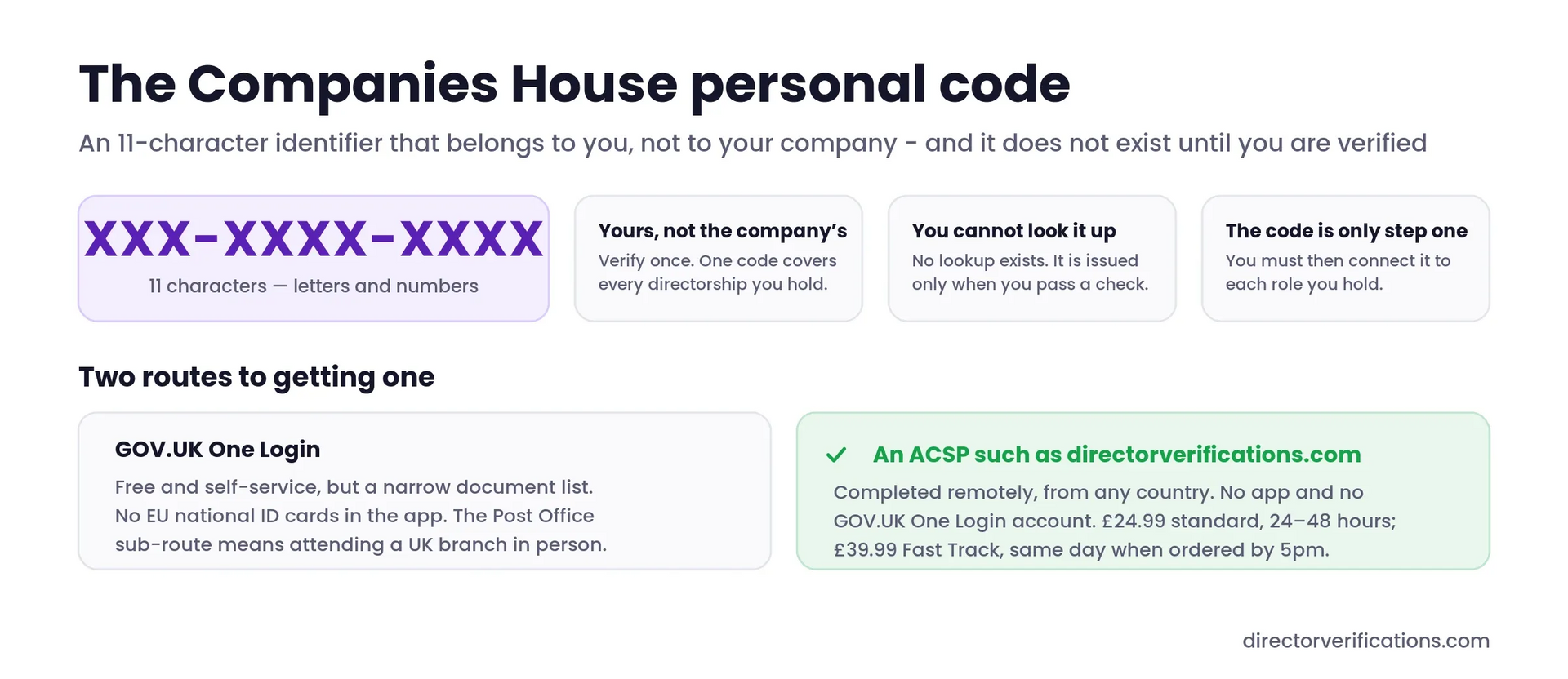
In short: A Companies House personal code is an 11-character identifier, formatted XXX-XXXX-XXXX, issued to you once you have successfully verified your identity with Companies House. It belongs to you as a person, not to any company. You cannot look it up in advance — it does not exist until you are verified. There are two routes to getting one: GOV.UK One Login, or an Authorised Corporate Service Provider (ACSP) such as directorverifications.com. Standard verification through directorverifications.com is completed within 24–48 hours for £24.99, with a same-day Fast Track option at £39.99.
If you are a UK company director, a Person with Significant Control (PSC), an LLP member or a general partner of a limited partnership, the phrase Companies House personal code has probably landed in your inbox at some point in the last few months — usually attached to a filing deadline you did not know you had.
Under the Economic Crime and Corporate Transparency Act (ECCTA) 2023, this code is now the mechanism by which you prove to Companies House that you are who you say you are. Without it, your company cannot file its confirmation statement, you cannot be appointed to a new board, and you cannot incorporate a new company.
Companies House has estimated that somewhere between 6 and 7 million people need to complete this process. A large number of them will leave it until their filing deadline is days away.
This guide covers what the code actually is, the exact steps to get one, the deadline that applies to your role specifically, and — the part most guides skip entirely — what to do when something goes wrong. It also explains why, for a significant group of non-British directors, an ACSP like directorverifications.com is not merely the easier route but the only route available.
What is a Companies House personal code?
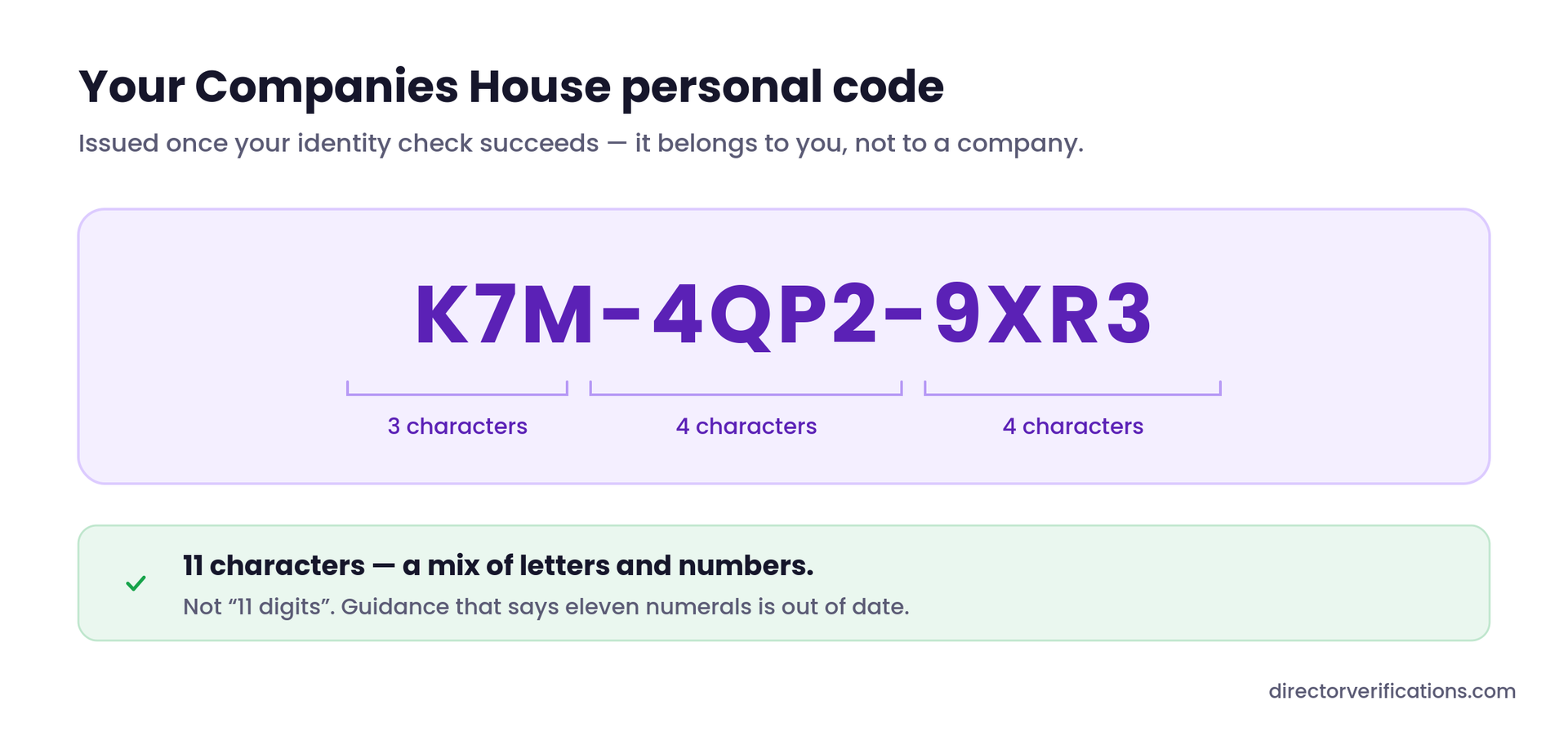
A Companies House personal code is a unique 11-character identifier issued by Companies House once you have successfully completed identity verification. It is formatted as XXX-XXXX-XXXX — a mix of letters and numbers.
Three things about it are worth understanding properly, because they cause most of the confusion we see at directorverifications.com:
1. It is personal, not corporate. The code attaches to you, not to a company. If you are a director of five companies, you verify once and use the same personal code for all five appointments. You should never verify a second time unless Companies House explicitly asks you to.
2. It cannot be looked up. There is no search tool, no register lookup, no "find my code" page. The code does not exist until the moment your identity check succeeds. If you are searching for how to find your Companies House personal code and you have never been verified, the honest answer is that you need to get one first — which is what directorverifications.com exists to do.
3. It is a credential, so treat it like one. Companies House compares it to your HMRC Unique Taxpayer Reference (UTR). You may need to share it with an accountant or agent who files on your behalf, but it should not be circulated casually. If you believe your code has been compromised, Companies House can cancel it and issue a new one.
There is a small inconsistency worth clearing up, because it appears across a lot of published guidance: the code is often described as "11-digit". It is 11 characters, and it contains letters as well as numbers. If a guide tells you to expect eleven numerals, that guide is out of date.
Who needs a Companies House personal code?
Identity verification — and therefore a personal code — currently applies to:
- Company directors of UK-registered companies
- The equivalent of a director, including LLP members, general partners of limited partnerships, and managing officers
- Directors of overseas companies registered in the UK
- People with Significant Control (PSCs) — see our detailed guide on what documents you need for a PSC personal code
- Authorised Corporate Service Providers (ACSPs) themselves — every ACSP, including directorverifications.com, has had to verify its own people before it could be authorised
Companies House has confirmed that verification will be extended at a later date to people who file at Companies House, limited partnerships, corporate directors, corporate members of LLPs, and officers of corporate PSCs.
Critically, there is no geographic exemption. A director living in Dubai, Lagos, Warsaw or Sydney has exactly the same obligation as a director living in Leeds. If you hold a UK company role, the requirement applies to you. Our guide to ID verification for non-UK citizen company directors covers the overseas position in detail.
The two-step process most people miss
Here is the single most common misunderstanding we encounter at directorverifications.com, and it causes real filing failures.
Getting your personal code is only step one. Companies House sets out two distinct steps:
- Completing a successful identity check — which produces your personal code.
- Providing an identity verification statement to Companies House, which supplies that code and connects your verified identity to the register.
You can be fully verified, holding your code, and still be non-compliant, because you have not yet connected it to your role. Directors do this through the company's confirmation statement. PSCs do it through the separate "Provide identity verification details for a PSC" service.
If you take one thing from this guide: verify early, then connect the code. Doing them in one panicked session before a filing deadline is how people end up in trouble.
Your deadline depends on your role — here is the actual rule
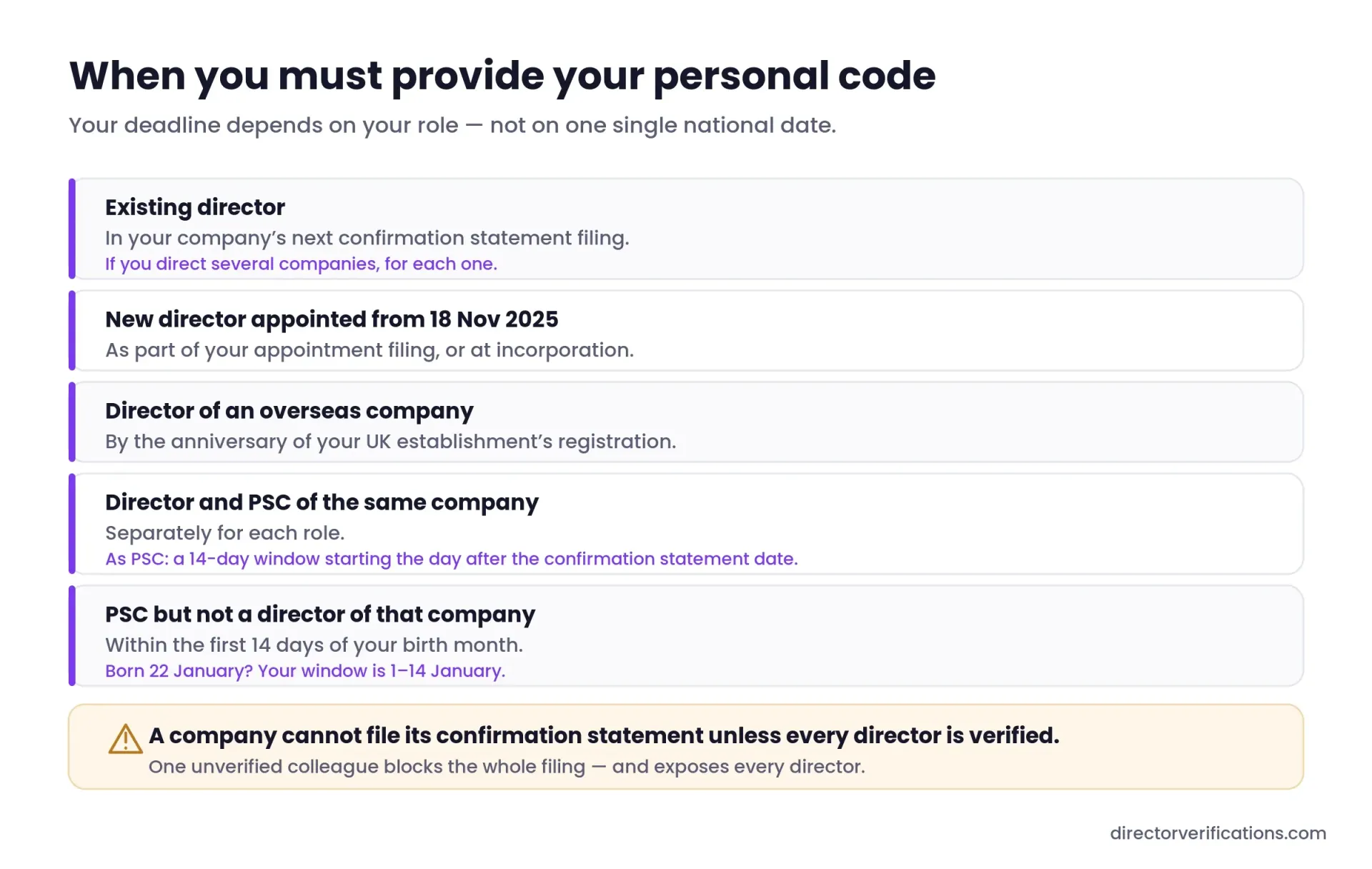
The widely quoted date is 18 November 2026. That is the practical backstop for existing office-holders, but it is not the rule that will actually catch you out. The real rules are these.
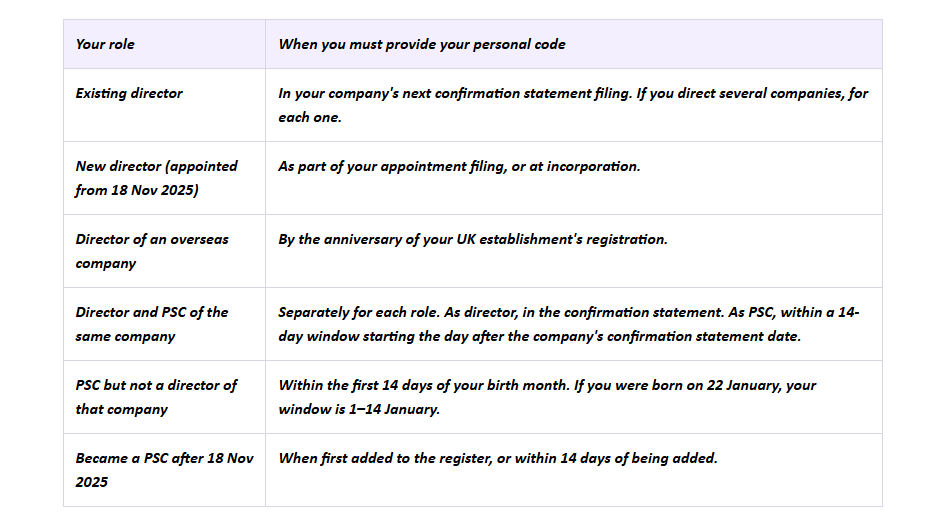
Two things follow from that table. First, a company cannot file its confirmation statement unless all of its directors are verified — so one unverified colleague blocks the whole filing, and every director is then exposed. Second, the PSC 14-day window is genuinely tight, and if your company files its confirmation statement early, your window does not move.
This is precisely why customers come to directorverifications.com rather than gambling on a self-service portal a fortnight before a hard deadline. If you are already inside a tight window, our Fast Track same-day verification service exists for exactly that situation.
How to get your Companies House personal code: the two routes
Route 1 — GOV.UK One Login (free, self-service)
GOV.UK One Login’s own route is its app, and it accepts only a narrow set of documents. This matters enormously and is almost never explained clearly:
- The One Login app. Requires a reasonably modern phone (iPhone 8 or newer on iOS 16.7+, or Android 10+). Accepted documents: UK photocard driving licence, UK passport, non-UK passport with a biometric chip, UK biometric residence permit, UK biometric residence card, or UK Frontier Worker permit.
Route 2 — an Authorised Corporate Service Provider (ACSP)
An ACSP is a firm authorised by Companies House to carry out identity checks on your behalf. To be authorised, it must be supervised by a UK Anti-Money Laundering (AML) supervisory body. directorverifications.com is a registered ACSP — it is the trading name of Finovium Limited, a firm of accountants, tax and business advisers based in Chelsea, West London, with over ten years of experience and AML supervision, ICO registration and HMRC tax agent authorisation behind it.
Companies House explicitly confirms you can use an ACSP from any country. Full detail on how the route works is on our What is an ACSP verification service page.
If you want the fuller picture before you choose one — what an ACSP actually is, who can register as one, and how to tell a good one from a bad one — read our complete guide to what is an ACSP.
The document problem for non-British directors
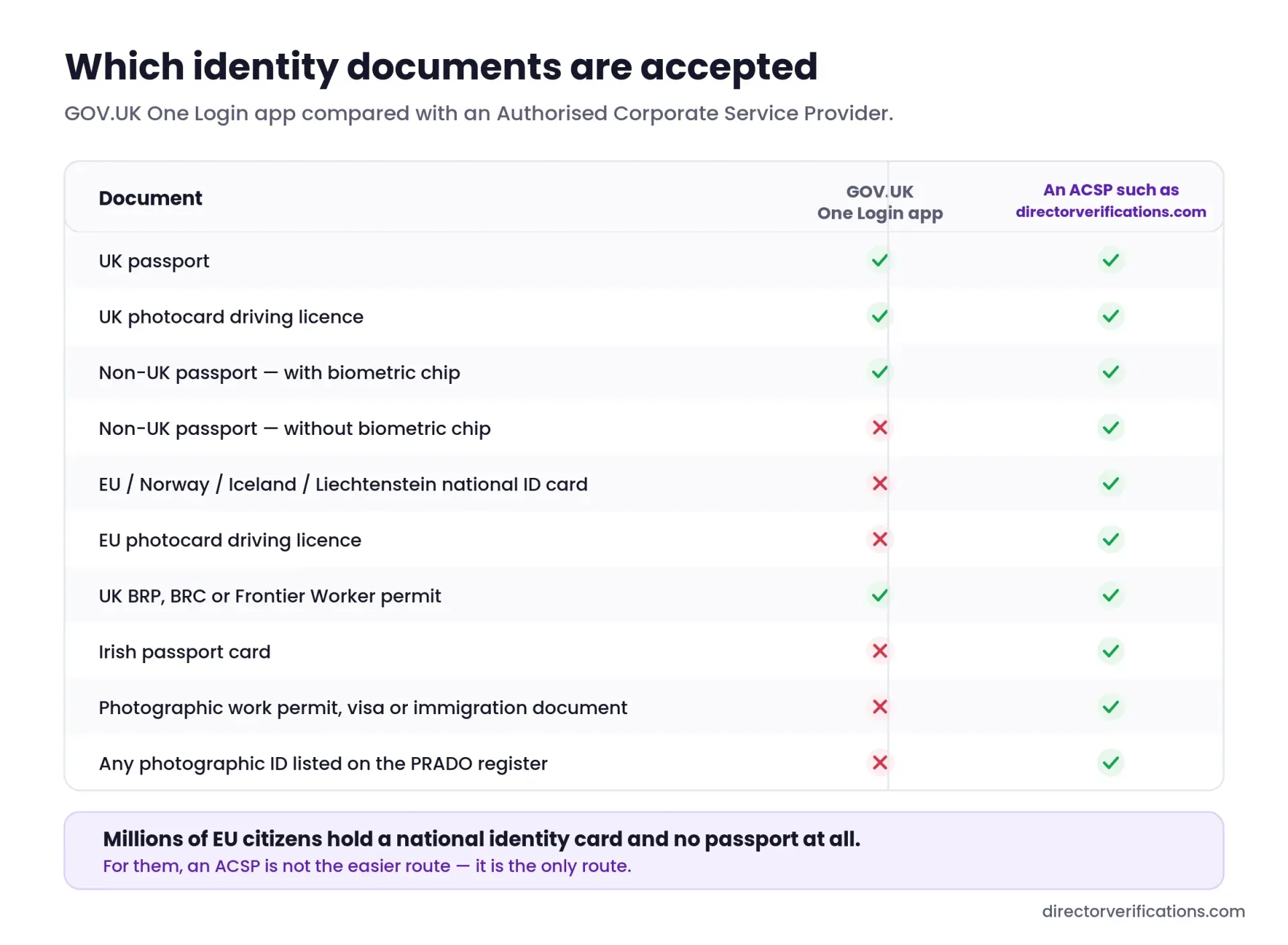
This is where the two routes stop being equivalent, and where a lot of overseas directors discover they are stuck.
Look carefully at the One Login app's accepted list. It takes a non-UK passport only if it has a biometric chip. It does not take a non-UK driving licence. It does not take an EU or EEA national identity card. And once GOV.UK One Login has refused you, the Post Office route isn’t open to you either.
There is a bigger problem than any of that, and almost nobody is told about it. If GOV.UK One Login refuses to verify you once, that is the end of the government route: you do not get a second attempt, and you cannot fall back on the Post Office option either, whatever the guidance says is available. You are locked out of GOV.UK One Login for an indeterminate period — often several weeks, sometimes several months. We know this at first hand as well as from our customers: when the government route would not verify our own director’s identity, we rang the Companies House helpline and were told plainly that the only route left was to use an ACSP.
Now compare that with the standard an ACSP works to. Under Companies House's published identity verification standard, an ACSP checking documents can accept, among others: a passport or Irish passport card, an EU/Norway/Iceland/Liechtenstein biometric identity card, a UK BRP or BRC, a UK or EU photocard driving licence, a photographic work permit, a photographic immigration document and a photographic visa. Checks may be completed remotely.
The practical consequence is straightforward. If you are a non-British director who holds a national identity card or a non-UK driving licence rather than a biometric passport, the GOV.UK route is effectively closed to you. An ACSP such as directorverifications.com is not the convenient alternative — it is the route that exists for you.
From what customers repeatedly tell us, this is not a fringe scenario. Millions of EU citizens hold a national ID card and no passport. And even among those who do hold a biometric passport, we hear constantly from directors whose app-based attempt failed for reasons they could not diagnose. Our guide to the problems with verifying directly through Companies House and our dedicated guide for non-British passport holders go deeper on this.
One reassuring point, because it is widely misunderstood: you do not need a passport. Government-issued biometric national identity cards and photocard driving licences are accepted, and overseas customers of directorverifications.com use them routinely.
Getting verified through directorverifications.com: step by step
Step 1 — Choose your service. Standard verification is £24.99 and is completed within 24–48 hours. Fast Track is £39.99 with a guaranteed same-day turnaround, provided your order reaches us by 5pm, seven days a week.
Step 2 — Provide your details. Companies House requires your ACSP to collect your full name, date of birth, home address and an email address. Your address is recorded, not verified — an ACSP is not required to prove where you live. Make sure the email address is one you can access — Companies House sends your personal code directly to that address, not to us.
Step 3 — Scan your document and your face. You will receive an email with a "Start Verification" link. No app installation. No GOV.UK One Login account at any point. Our verification partner uses enterprise-grade biometric AI, accredited to ISO 27001, eIDAS 2.0, ETSI, IEEE 2089.1-2024, NIST Level 1 & 2 PAD and ISO 30107-3 Levels 1 and 2. In the small number of cases where the AI cannot confirm a match, a trained human reviews the documents rather than simply rejecting you.
Step 4 — We submit to Companies House. directorverifications.com files your verified identity through the official Companies House ACSP portal.
Step 5 — Companies House emails your code. It usually arrives within a few hours of submission. Check your spam folder if it does not.
Step 6 — Connect it to your roles. Provide the code in your confirmation statement (as a director) or via the PSC service (as a PSC). Companies House also recommends saving your code to a Companies House account so you can retrieve it later.
If you are an accountant, solicitor or company formation agent handling several people at once, our bulk director verification service is built for exactly that — see also our guide to bulk director ID verification.
What appears on the public register
If you verify through an ACSP and then connect your code to the register, Companies House publishes a verification statement showing your name, the date your identity was verified, the name of the ACSP that verified you, and the AML supervisory bodies that ACSP is registered with. Your identity documents are never published.
Troubleshooting: when your code doesn't work
This section covers the questions our support team is asked most, and which almost no other guide addresses.
"I never received my code." If you verified through an ACSP, the code goes to the email address the ACSP supplied. Check spam first, then contact your ACSP to confirm the address they used. Note that directorverifications.com never receives your personal code from Companies House — we cannot look it up or recover it for you, which is why the email address you give us matters so much.
"I've lost my code." If you saved it to a Companies House account, sign in and look under Manage account. If you verified via GOV.UK One Login, sign in with the same email address you used and check Manage account there.
"Companies House says my details don't match." This usually means one of three things: the code was typed incorrectly; your date of birth is wrong on the Companies House record; or the ACSP submitted incorrect details for you. Check the date of birth held for you via WebFiling and correct it before trying again.
"I think my code has been shared or compromised." Contact Companies House directly. They can cancel the existing code and email you a replacement.
"The GOV.UK route already rejected me." A failed attempt does not disqualify you. An ACSP can still verify you — see our guide on the eight most common reasons Companies House ID verification fails, and our ECCTA compliance guide for the wider picture.
What happens if you don't verify
Companies House has published its enforcement approach, and it is not merely administrative. It is unlawful for a director to act as a director without completing identity verification — and where an individual director breaches the requirement, the company is also in breach.
The published enforcement toolkit includes prosecution through the courts, referral to the Insolvency Service, financial penalties at company or individual officer level, director disqualification, annotation of the public register against your name, and court orders. Companies House treats three or more offences over a five-year period as "serious", making prosecution more likely.
You will also be unable to be appointed as a new director, register a new company, or register as an ACSP.
There is a narrow representations process for genuinely exceptional circumstances — Companies House gives the example of a serious IT failure at the moment the statement was due — and the registrar has discretion to extend a PSC's due date by up to 14 days. Neither is a substitute for verifying on time.
Get your Companies House personal code today
Your personal code is now a permanent part of holding any UK company role. Getting one is not difficult, but the GOV.UK route quietly excludes a large group of people — particularly non-British directors whose documents fall outside a narrow accepted list, and anyone GOV.UK One Login has already refused.
directorverifications.com is a Companies House-approved ACSP that handles the whole process for you: no app, no GOV.UK One Login, human review where the technology needs it, and your code emailed straight to your inbox.
Standard service — £24.99, completed within 24–48 hours.
Fast Track — £39.99, guaranteed same day when ordered by 5pm, seven days a week.
Get verified for £24.99 — or contact the team at directorverifications.com if you would like to talk it through first.
Frequently Asked Questions
What is a Companies House personal code?
It is an 11-character code, formatted XXX-XXXX-XXXX, issued to you once you have successfully verified your identity for Companies House. It is personal to you rather than to any company, and you use the same code for every UK company role you hold.
How do I find my Companies House personal code?
You cannot look it up before verifying — it only exists once your identity check succeeds. If you verified via an ACSP such as directorverifications.com, Companies House emails the code to the address your ACSP supplied. If you verified via GOV.UK One Login, or if you saved your code to a Companies House account, you can view it under "Manage account" after signing in.
Is the personal code 11 digits or 11 characters?
It is 11 characters and includes letters as well as numbers, formatted XXX-XXXX-XXXX.
Do overseas directors need a Companies House personal code?
Yes. There is no exemption based on where you live. Companies House confirms you can use an ACSP from any country, and directorverifications.com verifies overseas directors remotely.
Can I get a personal code without a passport?
Yes. Government-issued biometric national identity cards and photocard driving licences are accepted document types, and an ACSP can accept a wider range of photographic ID than the GOV.UK One Login app.
Why can't non-British directors verify through GOV.UK?
The GOV.UK One Login app accepts a non-UK passport only if it has a biometric chip, and does not accept non-UK driving licences or EU national identity cards. And once GOV.UK One Login has refused you, the Post Office route isn’t open to you either. An ACSP such as directorverifications.com can complete the check remotely, from any country.
How long does it take to get a personal code through directorverifications.com?
Standard verification is completed within 24–48 hours. Fast Track is guaranteed same day if your order is received by 5pm, seven days a week. Companies House typically emails your code within a few hours of our submission.
How much does it cost?
£24.99 for the Standard service and £39.99 for Fast Track same-day verification.
Do I need to verify separately for each company I'm a director of?
No — you verify once and receive one personal code. However, you must provide that code separately for each company role, through each company's confirmation statement.
What happens if I lose my personal code?
If you saved it to a Companies House account you can retrieve it by signing in. Otherwise, contact Companies House. directorverifications.com does not receive or store personal codes, so we are unable to recover them.
Can Companies House reissue my code if it's compromised?
Yes. Contact Companies House and they can cancel your existing code and email you a new one.
What is the deadline for getting my personal code?
For existing directors, it is your company's next confirmation statement — with 18 November 2026 as the practical backstop for everyone. PSCs have a 14-day window that depends on their circumstances. Verifying with directorverifications.com well ahead of your deadline avoids the risk entirely.
Written by the directorverifications.com team
An ACSP registered with Companies House
directorverifications.com is the ID verification service of Finovium Limited, a firm of accountants and tax advisers based in Chelsea, West London. Finovium is registered with Companies House as an ACSP (Authorised Corporate Service Provider), registered with HMRC as an authorised tax agent, and registered with the ICO. We set this service up after the government's own ID verification route refused to verify one of our own directors, and we built it to provide a good value, hassle-free ID verification service for the people the government's free service rejects and turns away. More about us.
Other insights
More from directorverifications.com