Latest insights
What Documents Do You Need for a Companies House PSC Personal Code Application?

June 29, 2026
By directorverifications.com team
As the UK strengthens corporate transparency requirements, Persons with Significant Control (PSCs) must complete identity verification and obtain a Companies House PSC personal code. This unique code confirms that a PSC has successfully verified their identity and is authorised to be linked to UK company records.

The single biggest cause of delays is turning up to verification with the wrong documents. This guide explains exactly which documents Companies House accepts, how the two verification routes differ, why some applications get rejected, and how an Authorised Corporate Service Provider (ACSP) such as
directorVerifications.com can get you verified quickly and correctly the first time.
What is a Company's House PSC Personal Code?
A Companies House personal code is a unique 11-character code (a mix of letters and numbers) issued once you have successfully verified your identity. It is personal to you - not to your company -- so you verify once and use the same code for every UK company role you hold, now and in the future.
For PSCs, the code is part of the UK's drive to improve corporate transparency and make it harder to hide behind anonymous or fraudulent company structures. Note that “personal code” is the official term; you may also see it described loosely as a “PSC code” or “ID code,” but they all refer to the same 11-character personal code.
Who Needs a PSC Personal Code?
A Person with Significant Control is an individual who owns or controls a company. You are generally a PSC if you meet one or more of these conditions:
• You hold more than 25% of the company's shares.
• You hold more than 25% of the voting rights.
• You have the right to appoint or remove a majority of the board of directors.
• You otherwise exercise significant influence or control over the company.
• You exercise significant influence or control over a trust or firm that itself meets any of the above conditions.
If any of these apply to you, you must verify your identity and obtain a personal code. This applies to UK-based and overseas PSCs alike.
The Two Ways Your Identity Can Be Verified
Before listing documents, it helps to understand that there are two official routes, and the documents you need depend on which one you use:
1.
Verify yourself via the GOV.UK One Login service (usually using a smartphone app to scan a biometric document and take a selfie).
2. Verify through an ACSP (an authorised agent such as an accountant - this is the route directorVerifications.com uses), who checks your documents against the official Companies House standard and submits the verification for you.
Both routes must meet exactly the same Companies House identity verification standard, so neither is a “shortcut” on rigour - but using an ACSP means an expert handles the documents and submission, which significantly reduces the risk of rejection.
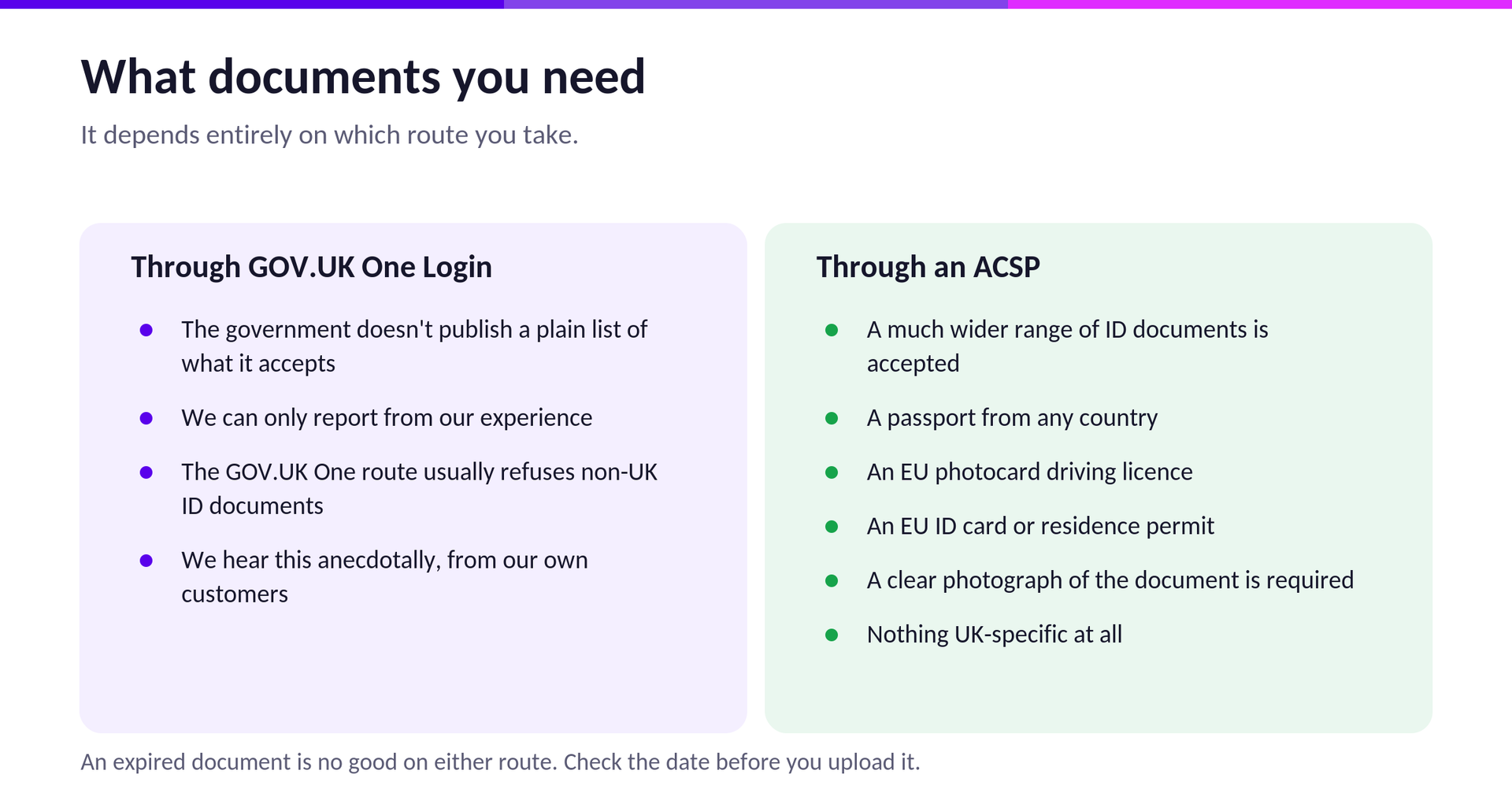
Documents Required for a PSC Personal Code
If you verify yourself through GOV.UK One Login
You will need one photographic identity document with a biometric chip that the app can scan, such as:
• A biometric passport (from any country)
• A UK photocard driving licence (full or provisional)
• A UK biometric residence permit (BRP) or biometric residence card (BRC)
• A UK Frontier Worker permit
You then take a short video selfie so the app can match your face to the document.
If you verify through an ACSP
An ACSP can check your identity to one of two standards:
Option 1 - one document, checked by technology. A single photographic document (for example, a biometric passport, an EU/EEA biometric identity card, a UK photocard driving licence, a UK BRP/BRC or a UK Frontier Worker permit) is validated using identity document validation technology, plus a check that you match the document.
Option 2 - two documents, checked by a trained person. You provide two documents in total: either two photographic identity documents, or one photographic identity document plus one supporting document. Supporting documents include a bank or building society statement, a UK council tax statement, a utility bill, a mortgage statement, or a birth or marriage certificate. Where a supporting document is used to confirm your address, it generally needs to be recent (typically issued within the last three months).
In all cases you will also be asked for some basic information: your full name and any former names, date of birth, current home address, and your address history for the last 12 months.
A note on expired documents
You generally cannot use expired documents, but there are specific exceptions. For example, a biometric passport can be accepted if it expired within the last 6 months when checked by technology (and up to 18 months when checked manually by an ACSP), and a UK BRP can be accepted up to 18 months after expiry. If in doubt, it is always safer to use an in-date document.
How the Verification Process Works with an ACSP
The process with directorVerifications.com is designed to be quick and stress-free:
- Gather your documents - have your photo ID (and, if needed, a recent proof of address) ready and clearly readable.
- Submit your details - provide your information and document images through our secure online process.
- Identity checks are completed - your documents are validated and your identity is confirmed to the Companies House standard.
- We submit your verification - we notify Companies House through the official ACSP portal.
- You receive your personal code - Companies House issues your 11-character personal code, which you then use for your PSC duties and any future filings.
As a regulated ACSP, we are also required to keep records of the checks we carry out for seven years, giving you a clear, compliant audit trail.
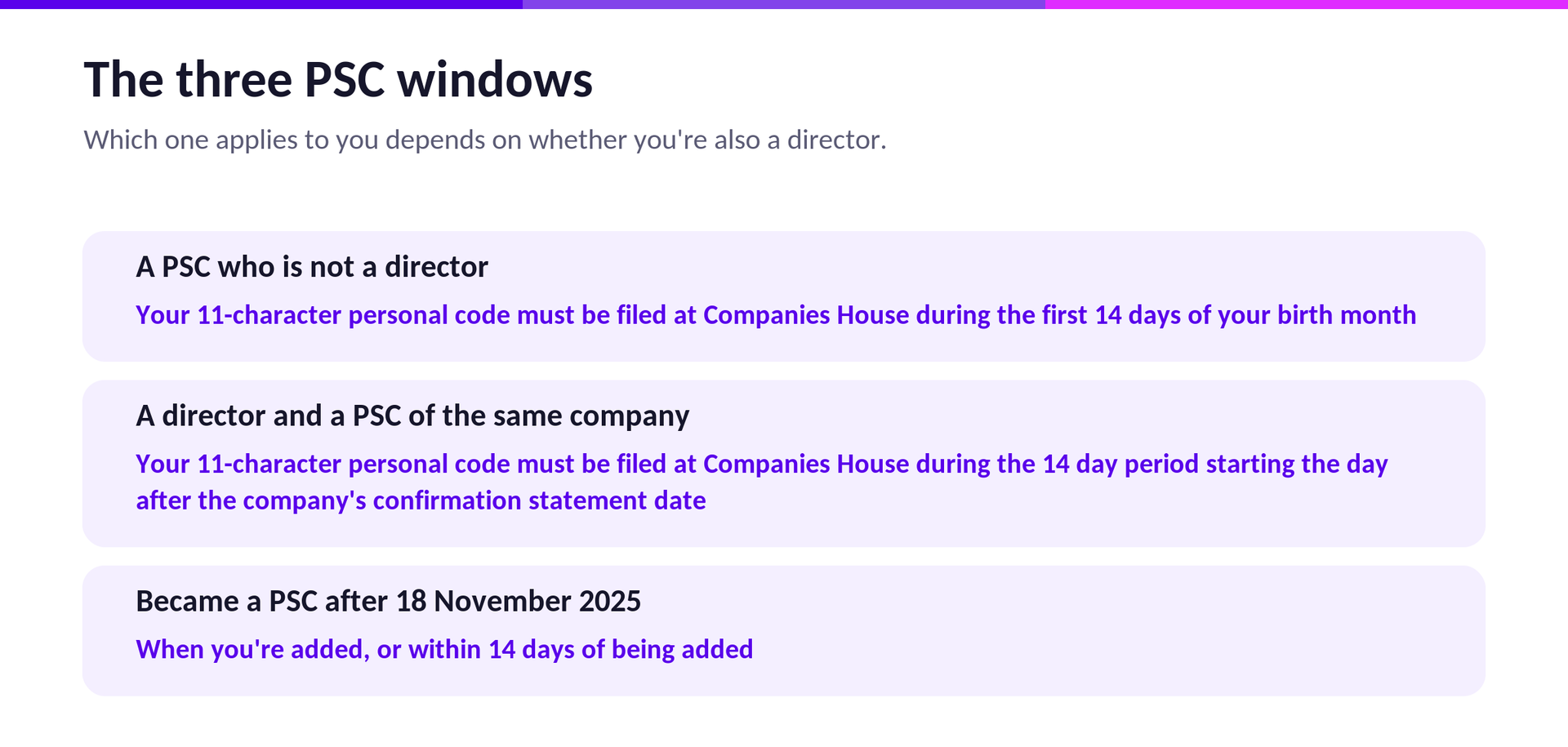
Key Deadlines PSCs Should Know
Identity verification became mandatory on 18 November 2025. Existing PSCs fall within a phased, 12-month transition period with a final backstop of 18 November 2026 - and in practice you will usually need to provide your personal code and a verification statement around the time of your company's next confirmation statement. Anyone becoming a PSC after 18 November 2025 must verify as part of that process. Leaving it late risks holding up your company's filings, so it is worth getting verified early.
Common Reasons PSC Applications Are Delayed
Most delays come down to avoidable document problems:
• Using an expired or out-of-date identification document
• Blurry, cropped, or poorly lit document images
• Proof-of-address documents that are too old
• Personal details that don't match across documents (for example, after a name change)
• Incomplete information, such as missing address history
A quick, expert document review before submission removes almost all of these risks.
Why Use a Professional Verification Service?
Verifying through directorVerifications.com gives you:
• Faster, smoother processing with fewer back-and-forth corrections
• A reduced risk of rejection thanks to an upfront document check
• Expert guidance on exactly which documents meet the Companies House standard
• Secure handling of your personal documents by a regulated firm
• A fast-track, same-day option when you need your personal code quickly
directorVerifications.com is operated by Finovium Limited, a West London firm of accountants registered with Companies House as an ACSP and supervised for anti-money laundering purposes by HMRC. Whether you are a UK or overseas PSC, we make verification simple and fully compliant.
Conclusion
Getting your Companies House PSC personal code starts with the right documents. Have a valid, in-date photo ID ready - and, depending on your route, a recent proof of address - and the process is usually quick. Get the documents wrong, and you risk frustrating delays at exactly the wrong moment. Using an experienced ACSP like directorVerifications.com takes the guesswork out of it, reduces the risk of rejection, and gets your verification done right the first time.
Ready to verify? Get your Companies House personal code with directorVerifications.com today.
Frequently Asked Questions
What is a Companies House PSC personal code?
It's a unique 11-character code issued by Companies House after a Person with Significant Control successfully verifies their identity. You use the same code for all your UK company roles.
What documents do I need for PSC verification?
At minimum, a valid biometric photo ID such as a passport. If your identity is checked manually by an ACSP, you may need a second document - either another photo ID or a supporting document such as a recent bank statement, utility bill, or council tax statement.
Do I need proof of address?
Not always. If your identity is verified using a single biometric document and a facial check, a separate proof of address may not be required. It is more likely to be needed where documents are checked manually. Either way, you'll be asked to give your current address and your address history for the last 12 months.
Can overseas PSCs get a Companies House personal code?
Yes. An ACSP can verify your identity from any country using documents from the approved list, which makes the ACSP route particularly convenient for overseas PSCs.
How long does verification take?
The information you provide takes only a few minutes. With directorVerifications.com, a fast-track same-day option is available, and Companies House issues your personal code once verification is submitted.
Is a “Companies House ID code” the same as a personal code?
Yes. The official term is “personal code.” Phrases like “ID code” or “PSC code” all refer to the same 11-character code issued after successful identity verification.
What is the deadline for PSCs to verify?
Verification has been mandatory since 18 November 2025, with a transition period ending 18 November 2026 for existing PSCs. In most cases you'll need your personal code by the time of your company's next confirmation statement.
Written by the directorverifications.com team
An ACSP registered with Companies House
directorverifications.com is the ID verification service of Finovium Limited, a firm of accountants and tax advisers based in Chelsea, West London. Finovium is registered with Companies House as an ACSP (Authorised Corporate Service Provider), registered with HMRC as an authorised tax agent, and registered with the ICO. We set this service up after the government's own ID verification route refused to verify one of our own directors, and we built it to provide a good value, hassle-free ID verification service for the people the government's free service rejects and turns away. More about us.
Other insights
More from directorverifications.com