Latest insights
Limited Partnership Partner ID Verification: What the 2026 Rules Mean and How to Get It Right

July 9, 2026
By directorverifications.com team
Limited partnerships occupy a unique position in the UK business landscape. Unlike limited companies, they historically filed far less public information, which made it harder for regulators, banks and counterparties to confirm exactly who stood behind them. That era is ending. Under the Economic Crime and Corporate Transparency Act 2023 (ECCTA), limited partnerships face the biggest shake-up since the Limited Partnerships Act 1907 - and identity verification of partners now sits at the centre of it.

This guide explains what limited partnership partner ID verification actually involves, what is changing in 2026, who must verify, and why using an Authorised Corporate Service Provider (ACSP) such as directorVerifications.com is now the simplest and safest way to stay compliant - especially if any of your partners hold overseas passports or ID.
The 2026 Shake-Up: What's Really Changing for Limited Partnerships
Most articles on this topic stop at "verify your partners." The reality is more significant, and getting ahead of it is a genuine competitive advantage. Under ECCTA, being rolled out during 2026 through secondary legislation, UK limited partnerships must adapt to a new regime:
•
All Companies House filings must be made through an ACSP. This is the big one. Limited partnerships can no longer file directly with Companies House - every statutory filing must be submitted by an
Authorised Corporate Service Provider (an authorised agent registered with Companies House). Choosing your ACSP is therefore no longer optional; it's a structural requirement.
•
General partners must verify their identity. Individual general partners must complete Companies House identity verification.
•
Corporate general partners must name a verified "registered officer." Where a general partner is itself a company or entity, it must nominate a registered officer - an individual managing officer (such as a director) - whose identity is verified.
•
Confirmation statements and 14-day updates. Limited partnerships will have to file annual confirmation statements and notify Companies House of changes to partners' details within 14 days.
•
A transition period for existing LPs. Existing limited partnerships get a limited transitional window (around six months) to provide registered officer details and bring themselves into line.
In short: verification and ACSP-based filing are becoming inseparable for limited partnerships. That's exactly why partnering with directorVerifications.com early is the smart move.
What Is Limited Partnership Partner ID Verification?
Partner ID verification is the process of confirming that the relevant partners in a limited partnership are who they claim to be, to the
Companies House identity verification standard. In practice, for the individual being verified, it comes down to two things:
• Their full legal name and date of birth, and
• A valid,
government-issued biometric photo ID - a passport or an accepted photocard driving licence.
Once verified, the individual receives a unique
11-character Companies House personal code (a mix of letters and numbers). That code is tied to the person, not the partnership, so a partner who is also a company director or PSC elsewhere verifies only once and reuses the same code across every role.
A note on addresses. Each relevant partner's address must be provided to Companies House, but the address itself does not have to be independently verified. Because a limited partnership must file through an ACSP, directorVerifications.com submits the address to Companies House on the partnership's behalf - the partnership cannot do this itself - and there is no requirement to produce or check proof-of-address documents as part of the identity check.
Who Actually Has to Verify - General Vs Limited Partners
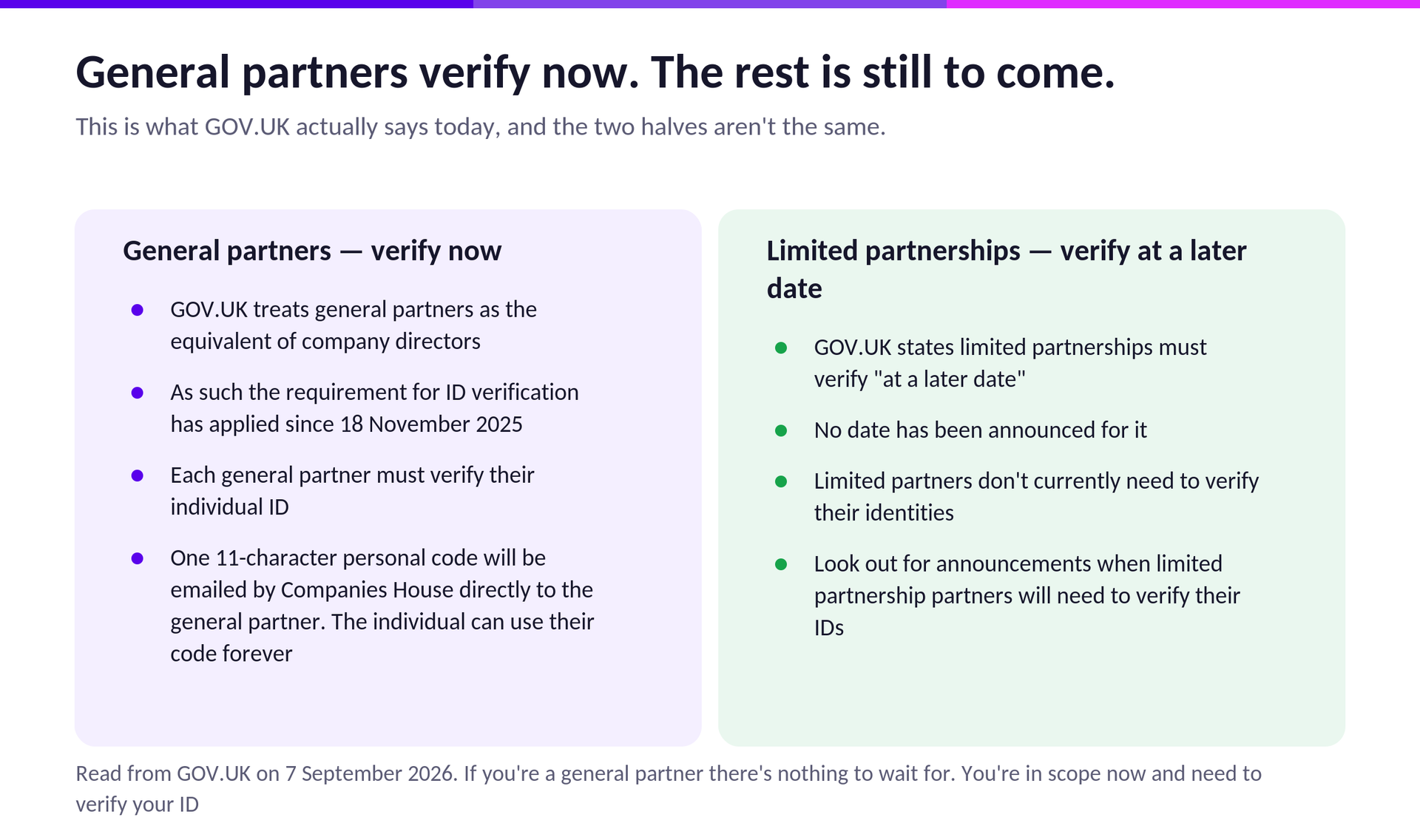
This is where many partnerships get it wrong, and where accurate guidance matters:
•
General partners (who manage the partnership and bear unlimited liability) are subject to identity verification.
•
Corporate general partners must nominate a
registered officer - a verified individual - rather than the entity verifying "itself."
•
Limited partners (typically passive investors who contribute capital but don't manage the business) must be named and their details provided to Companies House, but they are
not subject to the same identity-verification duty as general partners.
If your structure involves corporate partners, verification must "look through" to the real people who ultimately own or control that entity - the equivalent of a
PSC verification - not just confirm the company's registration.
Why Partner ID Verification Matters
Compliance is no longer optional. With Companies House gaining statutory verification powers and LP-specific rules landing in 2026, failing to verify the right partners can lead to rejected or blocked filings, penalties, and - in serious cases - the partnership being removed from the register.
It closes a known fraud gap. UK limited partnerships (and Scottish Limited Partnerships in particular) have historically been exploited to obscure beneficial ownership. Robust identity checks are precisely the reform intended to shut that door.
It protects business relationships. Banks, investors and counterparties increasingly want assurance they're dealing with verified individuals before opening accounts, extending credit or signing. Verified partners speed up due diligence on every side of a deal.
It builds long-term trust. A partnership that can demonstrate a clean, verifiable ownership structure is simply easier to bank, fund and do business with.
How Verification Works in Practice (with an ACSP)
A well-run process is quick and audit-ready. With directorVerifications.com it works like this:
1.
We send each partner a secure verification link. Each partner receives an email from us and clicks the "Start Verification" button, which transfers them to our ID verification partner's portal. There they scan their ID document (passport, etc.) and then scan their face - using the camera on their smartphone, laptop or desktop PC. There is nothing to download.
2.
The document is validated and matched to the person. The document's security features are validated and the live facial scan confirms it genuinely belongs to the person presenting it. There is no requirement to run credit-reference or database "background" checks - verification is about proving the document is real and belongs to the individual, to the Companies House standard.
3.
We submit it to Companies House on your behalf. As an authorised agent, directorVerifications.com files the verification - and the partner's address - through the Companies House ACSP portal. Because a limited partnership cannot file directly, we handle the submission, and can take care of the partnership's wider filings too.
4.
Companies House issues the personal code. Each verified individual is sent their own 11-character personal code by Companies House, directly to their inbox. We are not sent the code and do not store it - it stays with the individual, who reuses it for all their roles.
Why Use an App Like Directorverifications.com for Your Partnership
Because limited partnerships must now file through an ACSP, the practical question isn't *whether* to use one - it's *which* one. directorVerifications.com gives partnerships and funds:
•
One partner for verification and filing. We verify the individuals and handle the Companies House submissions, so nothing falls between the cracks.
•
Bulk verification for funds and larger LPs. Rather than checking partners one at a time, we process many partners through a single, efficient workflow - ideal for investment funds onboarding multiple limited partners or a group of general partners at once.
•
Speed when it counts. A same-day fast-track option means verification never becomes the bottleneck that holds up a banking approval or an investor closing.
•
Expert handling of complex structures. Corporate general partners, registered officers, and PSC "look-through" are handled correctly the first time.
•
No failed-verification headaches for overseas partners. Our AI-based technology reliably reads non-UK passports and international IDs that the government system often can't.
•
Secure, compliant document handling by a regulated firm supervised for anti-money laundering by HMRC.
Overseas Partners and Non-Uk Documents: the Biggest Hidden Risk
Here is the issue that catches out funds and international partnerships - and one the free government route rarely warns you about. Companies House's own GOV.UK One Login verification is built around UK documents and UK addresses, and it frequently struggles with non-UK passports and foreign driving licences. The result is failed verifications for exactly the partners who are hardest to re-verify: overseas investors and non-resident general partners.
This is exactly where directorVerifications.com is different. We use a specialist third-party identity-verification partner whose
state-of-the-art AI verification technology is built to read and validate non-UK documents, as well as foreign biometric passports and international ID - quickly and reliably. Where the government system chokes on an overseas passport, our technology handles it with ease.
A biometric or machine-readable passport is accepted from any nationality, so overseas partners can verify with the document they already travel on. You do not need a UK address to verify, and directorVerifications.com can verify partners from anywhere in the world.
Special Cases Worth Knowing
• Scottish Limited Partnerships (SLPs) have separate legal personality and have attracted particular regulatory attention; the same verification and ACSP-filing expectations apply, and SLPs are a common focus of enforcement.
•
Private Fund Limited Partnerships (PFLPs) used in the funds world still have general partners who must verify - the "fund" wrapper doesn't remove the obligation.
• Changes mid-life. New general partners must be verified when they join, and partner detail changes must be reported within 14 days - verification is not a one-and-done event.
Common Mistakes To Avoid
• Assuming limited partners must be fully verified (or that general partners needn't be). Get the general/limited distinction right, and remember corporate general partners need a verified registered officer.
•
Skipping the corporate partner "look-through." Confirming a corporate partner's name isn't enough - the real individuals behind it must be identified.
•
Leaving it to a deadline. Build verification into onboarding from day one so it never holds up a bank facility or an investor closing.
• Informal checks. Emailed screenshots of ID don't meet the standard; only formal, documented verification protects the partnership later.
Deadlines and Consequences
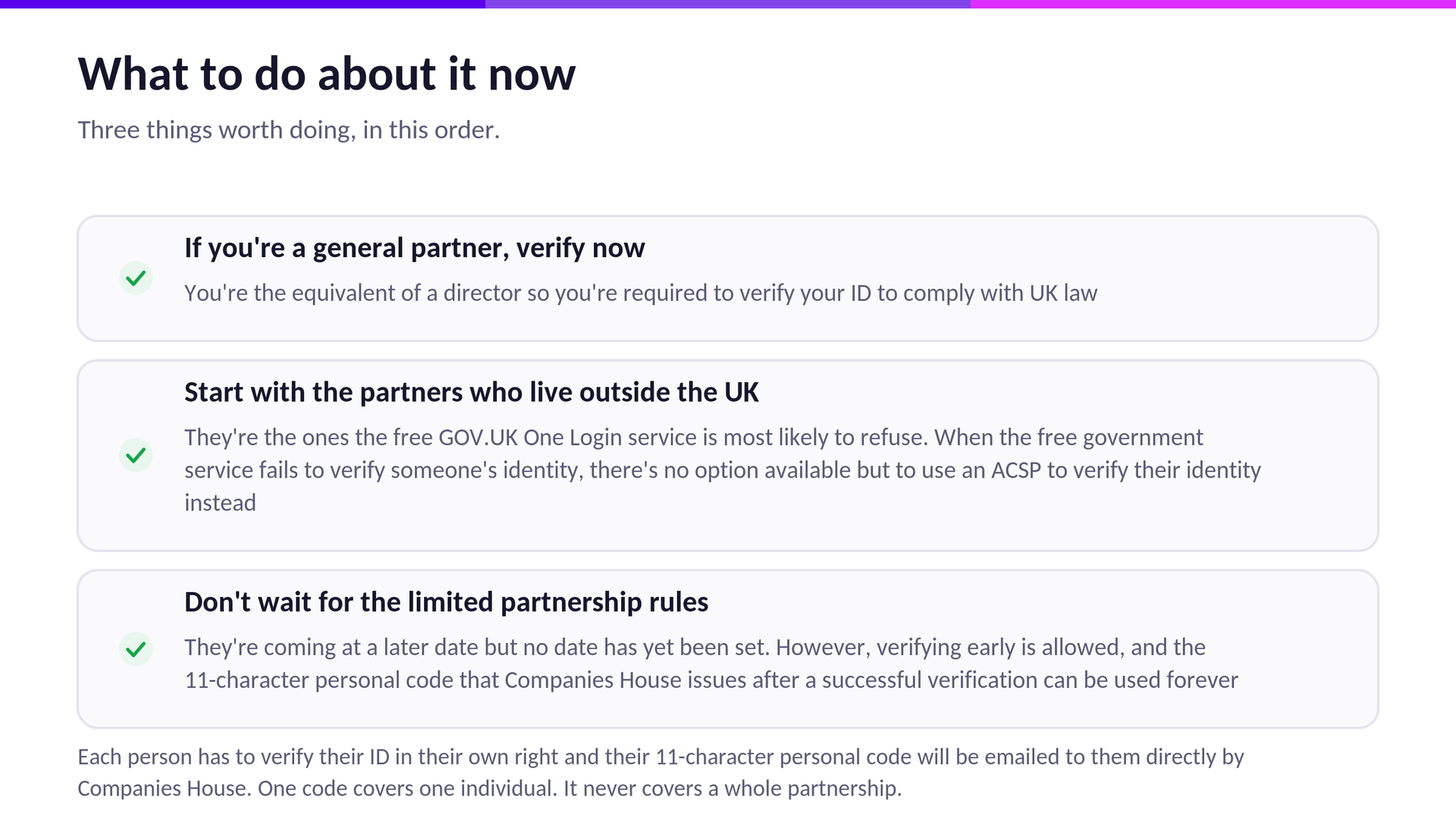
Identity verification became mandatory for company directors and PSCs on 18 November 2025. The limited partnership–specific reforms are being introduced during 2026 under secondary legislation, with a short transition window for existing LPs to provide registered officer details and comply. Because LPs must file through an ACSP and meet confirmation-statement duties, the practical work often needs to start well before any hard deadline. Non-compliance can mean blocked filings, financial penalties, and removal from the register - so acting early is the low-risk choice.
How to Get Verified with Directorverifications.com
1. We email each partner a secure verification link and they register their details - it takes 1–2 minutes.
2. Each partner clicks "Start Verification," then scans their passport and their face using the camera on their smartphone, laptop or desktop PC.
3. Our verification partner's AI technology validates the document in seconds - including non-UK passports.
4. We file the verification, and the partner's address, with Companies House through the ACSP portal on the partnership's behalf.
5. Companies House emails each partner's 11-character personal code straight to their own inbox.
Our standard service is £24.99 (usually within 24–48 hours, often quicker) and our fast-track same-day service is £39.99 when you register and pay before 5pm, seven days a week.
For funds and larger partnerships, ask about bulk verification.
Ready to verify your partners - and take the filing headache off your desk? Get started with directorVerifications.com today.
Frequently Asked Questions
Is partner ID verification a legal requirement for UK limited partnerships?
The limited partnership reforms under ECCTA are being introduced during 2026 and require general partners to verify their identity, corporate general partners to nominate a verified registered officer, and all filings to be made through an ACSP. Existing partnerships have a short transition period to comply, so most LPs should treat verification as a requirement to plan for now.
Do limited partners have to verify their identity?
Generally no - the identity-verification duty falls on general partners (and the registered officers of corporate general partners). Limited partners' details must still be provided to Companies House, but limited partners are not subject to the same verification requirement.
Do we have to verify each partner's address?
No. Each relevant partner's address must be provided to Companies House, but the address does not have to be independently verified as part of the identity check. Note that the partnership cannot submit this itself - limited partnership filings must be made through an ACSP such as directorVerifications.com, which submits the address on the partnership's behalf.
Can partner ID verification be done in bulk for large partnerships or funds?
Yes. directorVerifications.com processes many partners through a single bulk workflow, which is ideal for investment funds and larger partnerships onboarding multiple partners at once.
Our partners are based overseas with non-UK passports - can you still verify them?
Yes, and this is a particular strength. The government's GOV.UK One Login route often struggles with non-UK documents. directorVerifications.com uses a third-party partner with state-of-the-art AI verification that reliably validates non-UK biometric passports, and we can verify partners from any country using the passport they already travel on.
Why must we use an ACSP at all?
Under the reforms, UK limited partnerships can no longer file directly with Companies House - all filings must go through an Authorised Corporate Service Provider. directorVerifications.com is an ACSP, so we can both verify your partners and handle the partnership's Companies House filings.
How does partner verification relate to PSC compliance?
Where a corporate partner is involved, verification must identify the individuals who ultimately own or control that entity - the same "look-through" as PSC verification - so the partnership's ownership is fully transparent.
What is the Companies House personal code?
It's a unique 11-character code issued to an individual after successful identity verification. It's personal to the individual and reused across all their roles - partner, director, PSC or LLP member - so they only verify once.
Written by the directorverifications.com team
An ACSP registered with Companies House
directorverifications.com is the ID verification service of Finovium Limited, a firm of accountants and tax advisers based in Chelsea, West London. Finovium is registered with Companies House as an ACSP (Authorised Corporate Service Provider), registered with HMRC as an authorised tax agent, and registered with the ICO. We set this service up after the government's own ID verification route refused to verify one of our own directors, and we built it to provide a good value, hassle-free ID verification service for the people the government's free service rejects and turns away. More about us.
Other insights
More from directorverifications.com